Monday, April 23, 2012

Earth Day 2012 in Our Backyard

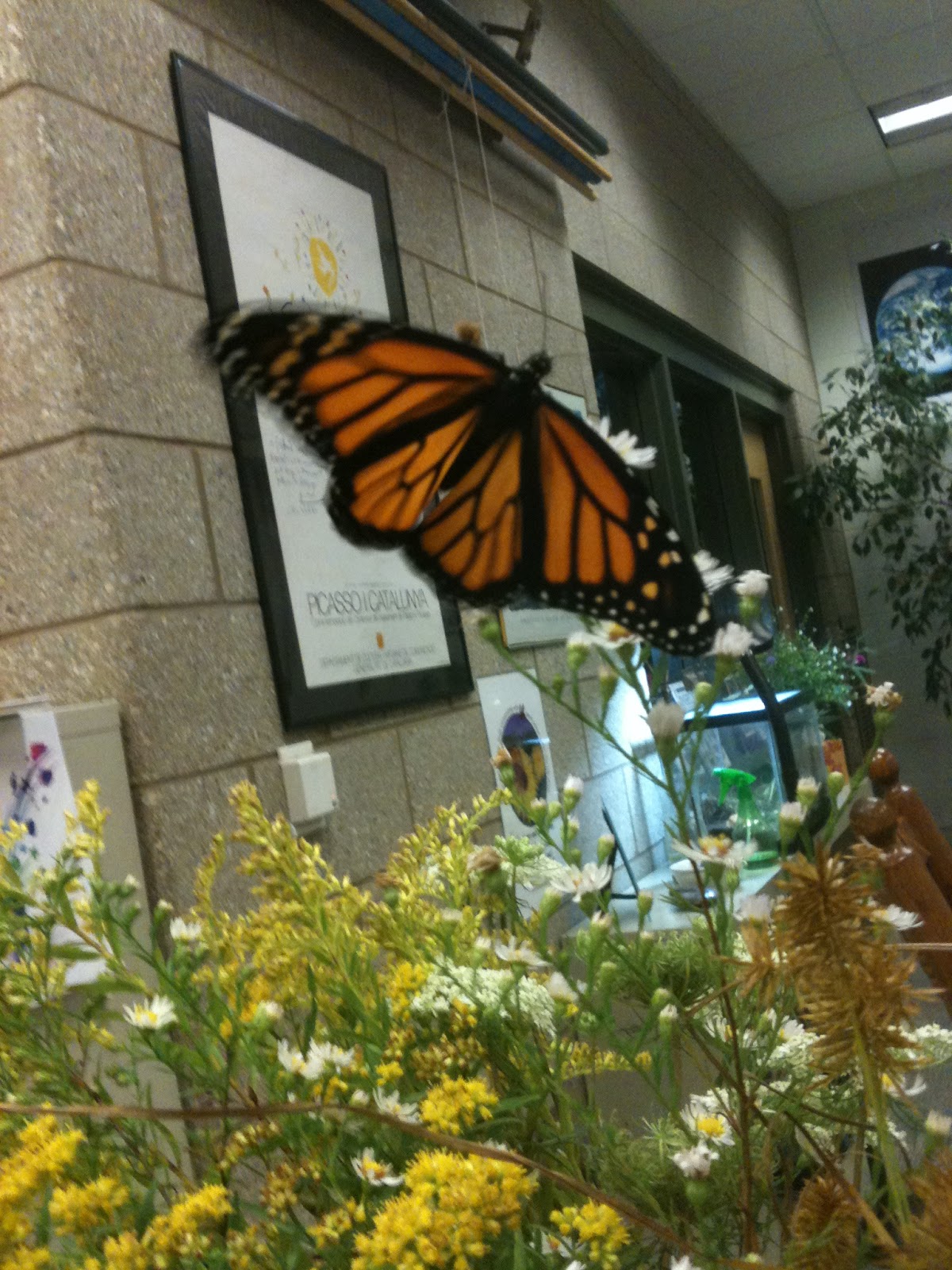
An old friend we hope celebrated Earth Day in Mexico
I had a wonderful Earth Day thanks to many good people and an amazing planet!  My day started out with an early morning "birding" expedition led by Russ Schipper, bird expect and educator.  I was the most novice in the bunch, so I kept my mouth shut and my eyes peeled, which seems to be good practice for most times (I just sometimes forget).  The wind was pretty strong and the air cold as we started out at the North Pier and traveled along our coastline, ending up at the state park.  My favorite spotting was of a flock of mergansers.  They are pretty amazing ducks.  They seem very pleased with themselves, especially the males (I feel as if you can add your own comment here).  It was a great adventure!  I got home and found out that I was bitterly cold.  Apparently I had been too interested in birds to have noticed how cold I really was . . . a sign of a great adventure.  It took a large bowl of oatmeal and a warm blanket to revive me.   


I attended the Liberty Hyde Bailey Museum's Earth Day celebration later that day.  It was a well attended and a really lovely event.  John Stempien reminded us of how Liberty Hyde Bailey saw the beauty and sacredness in all the earth.  I think everyday was Earth Day for Mr. Bailey.  He loved the great and the small of it and all the in between of it.  He must have smiled looking down at all of us in his old homestead, celebrating the earth.  Anne Long gave a short history of Earth Day from the 1970's and reminded us of how really far we have come and how important it is to stand up and be heard.  Little things, done together can make a big difference.  That's the spirit of Earth Day . . . We also had a guest speaker, Maynard Kaufman, who talked about saving the earth in our backyard.  He reminded us that biodiversity is critical to a vital ecosystem.  One step toward promoting biodiversity is to decrease (or eliminate) those manicured grass lawns!  He also stressed the importance of planting native species of trees, flowers and perennials.  His ideas were practical, simple and earth friendly.  Learn more about Mr. Kaufman and his earth friendly techniques and ideas on the Liberty Hyde Bailey Museum Website.  I hope to see many of you at the fun and educational events the museum offers through the year.  It is always a good time filled with amazing people and generous hospitality.  Happy Earth Day to all of you that make this planet your home!  

Wednesday, April 11, 2012

Dandelion Patch

Photo taken by D~
"Little Children like the dandelions, why may not we?" 
--Liberty Hyde Bailey


The dandelion patch that we planted in honor of Liberty Hyde Bailey is alive and well!  My son and I spent some time pulling out the extraneous weeds and we even found a few volunteer dandelions on our path that we transplanted to the garden.  Dandelions never had it so good! 


Spring is here and thoughts of growing the Liberty Hyde Bailey Interpretive Garden Path are at hand.  On Tuesday, April 24th at 7:00 p.m. there will be a meeting for anyone interested in the project.  We will be meeting at the Liberty Hyde Bailey Museum.  We need you.  We need everyone who is interested in building an outdoor learning environment for the students of North Shore Elementary.  You do not have to be an expert in anything, just someone who thinks kids need an outdoor setting to expand their learning and you want to help make it happen. 


The agenda is short.  We have two Eagle Scout projects and a Girl Scout project to showcase and discuss.  They will need our help as they plan and develop an outdoor seating area, a floating walkway on the wetlands and a certified Monarch Way Station. 


Other dreams include ideas for more plantings, grant writing, caring for the blueberry bushes (looking for a blueberry expert) developing a handicapped accessible path, curriculum work and more . . . The sky is the limit . . . as long as we have you with us.  Consider joining this amazing group of people for a short meeting at the museum.  I have been perfecting an old family brownie recipe, so brownies will be served.   I hope that you can join us!  If you are far away and/or cannot attend but have ideas, feel free to send them our way.  We are happy to serve!  liberty.hyde.gardens@gmail.com 


Tuesday, April 3, 2012

Springtime on the Path; Curriculum Connection

A big thank you to Russ Schipper for adding two bluebird houses to our backyard!  His knowledge and enthusiasm in teaching us about birds and his donations to the path are a generous addition to the education here at North Shore.  Thank you Russ!  This upcoming quarter, my students will be studying organisms in science.  The big idea with this unit is to discover how plants and animals adapt to their environment and to examine the characteristics of those different environments.  Why do different plants and animals grow and live in different places?  This is a great question for our backyard study.  Within the four acres in our school backyard, we have grassland, woodland and wetland.  Our path meanders through the different environments and for those of us who wander it, we get a peek into those natural surroundings and the plants and animals that have adapted there.  I can't wait to take my students out next week and listen to the frogs in the wetlands and see if the ferns have started growing underneath the trees.  No doubt there will be a variety of insects and other small creatures enjoying the warmth of spring in all the different areas. 

There are lots of ways to learn.  As we study the brain one thing is clear, knowledge is based on making connections.  We learn by connecting what we know to what we want to learn.  Students who love music, can connect new knowledge to sounds and tunes.  Students who love drawing, can connect new knowledge to art.  Students who love to move, can connect learning in hands-on study.  The Liberty Hyde Bailey Interpretive Garden Path has the potential to connect with students in a variety of ways that the classroom cannot always provide.  It's a place of beauty that can ignite the artist.  It's a place of amazing sounds (birds and crickets, frogs and toads) that can connect the auditory learning.  It's a place to move and explore, that can connect to those active learners.  Building connections in the brain, makes learning fun, but also makes students smarter.  It builds on what we know. 

My students had the opportunity to read poetry at Foundry Hall, our local theater.  Foundry Hall has generously let us use their wonderful facility for several years now, as my students celebrate poetry.  We filled the theater and ran out of programs.  Thank you Andru Bemis and Foundry Hall!  At any rate, some of our poetry was inspired by what we learned and what we observed on our path.  What is writing, if not an outcome of the world that surrounds us?

I Am Bluebird
By Makaelee 

I feel the wind on my feathers as I fly
I observe the kids playing outside
I wonder why the leaves change in the fall
I taste birdseed from the feeder
I dream of dancing on the clouds
I sing my cheerful song
I am Bluebird

Ice Crystals
By Zander
(a Haiku)

Frozen drops of rain
Sparkling white and fluffy
Then water beneath my feet


We have big plans for the Liberty Hyde Bailey Interpretive Garden Path.  Our goal is to make it an outdoor learning center that inspires students and teachers.  We will be getting together to plan and make goals for the future development of this project after spring break.  Details will follow in the days ahead.  Everyone is invited and chocolate is generally provided!  I hope to see you there!

Monday, February 20, 2012

Backyard Bird Count on the Liberty Hyde Bailey Interpretive Garden Path

Quietly watching for birds with binoculars in hand

Today, my students took part in the 15th Annual Great Backyard Bird Count, through Cornell University.  We have been learning about the winter birds in our backyard with the help of Russ Schipper, from the Kalamazoo Audubon Society and two friends from the Liberty Hyde Bailey Museum, Anne Long and George Miller.  Russ came to our classroom a week ago with lots of cool information and real stuffed birds!  His presentation sparked a great deal of questions and enthusiasm for the birds in our backyard.  Today he was back, along with Anne and George to count birds in our backyard.  He led my students out in small groups with binoculars to quietly watch birds.  Among the birds we saw and/or heard were cardinals, chickadees, geese, crows, downy woodpeckers, an American goldfinch, a white-breasted nuthatch, a red-winged black bird and a seagull!  It was an amazing experience.  We submitted our findings online and were one of thousands of groups all across North American, watching and recording birds this weekend (http://www.birdcount.org/).  We also read Liberty Hyde Bailey's first published essay entitled Birds.  He wrote and presented the essay at the age of 15 to the Michigan State Pomological Society at South Haven, September 4, 1863.  His goal was to educate the farmers on the importance of birds to the well-being of fruit farms.

"Mr. President, Ladies and Gentlemen, -- When the rigors of winter are over, and the pleasant days of spring return, what is more charming and delightful than the presence of birds?  What is more useful in destroying the myriads of insects which infest our vegetation?  Each one, from the different kind of insects it destroys, is almost indispensable to every farmer and fruit grower." 

He went on to describe in great detail different species of birds and the specific insects and noxious plants that they devour.  He finished his presentation with a poem he wrote in six verses.  The first two verses are as follows:

The robin sings sweetly from her native bowers,
The humming-bird sips the dewy flowers,
And the blue-jay's voice is often heard
From the forest, by fragrant breezes stirred.

The thrush, perched upon some lofty tree
That overshades the way,
Pours forth her song with joy and glee.
As if to welcome the coming day.

We have had a wonderful morning of bird watching, reading and enjoying the beauty of our South Haven home.  A heartfelt thank you to all who joined us for this adventure in learning . . . from those who loaned us binoculars to Anne and George and a special thank you to Russ Schipper! 

Sunday, January 15, 2012

"One day in February we were, with much enjoyment, wading through a drifted highway that skirted a forest, the least twig of which bore a burden of soft snow.  Over all hung that silence of winter which is the most 'silent silence' . . . No breeze swayed a creaking branch or shook from it the snow in soft thud to the white carpet below.  Even the song of the brook was smothered beneath coverlets of ice and pillows of drift.  We stood fast, awed by the stillness, when suddenly it was broken by the thrilling notes of the chickadees.  We could hardly credit our senses, for it seemed as if the woods was a hopeless place for any living creature that morning.  But there before our eyes was a flock of these courageous birds hunting for food on the leeward sides of boles and branches left bare and black in the recent storm.  Their ting weights sent the snow in showers from the terminal twigs . . . " 

--Liberty Hyde Bailey, December 1903, Cornell Nature-Study Leaflets, The Chickadee

Winter in our Backyard


Snow has finally arrived here in South Haven!  Our trail has a few inches of fresh snow and everything seems to sparkle.  Today I was out looking for signs of life and enjoying a beautiful sunny winter day.  I didn't see any animals, but I did hear several bird calls and I saw lots of animal tracks.   


On February 17th and 20th, my class, along with the Ann Long (Liberty Hyde Bailey Museum Board director, retired teacher, bird lover and friend) will be taking us out in small groups to participate in the Great Backyard Bird Count!  This event is hosted by Audubon, the Cornell Lab of Ornithology and Canadian partner Brid Studies Canada.  Anyone can participate.  The results will provide a snapshot of the whereabouts of more than 600 species of birds.  We will watch and count birds for at least 15 minutes and enter our results at http://www.birdcount.org/.  The four-day count typically records more than 10 million observations from across North America.  We are looking forward to observing and participating in this exciting event!

Monday, January 2, 2012

Class Pet


Meet Maude.  She's our latest addition to Fourth Grade.  Maude is a 24 year old iguana.  How cool is she?!  Our classroom theme is "In Our Backyard," and although Maude is not native to Michigan, she was formerly living in the nearby middle school (technically our backyard) for many years.  Her latest owner, a now retired science teacher, donated her to our classroom.  Sometimes backyards are full of surprises.  The average life expectancy for iguanas is about 15 years, so we have an old lady on our hands (actually two if you count me).   I am looking forward to sharing this new found friend with my students.  We will have to figure out how to keep Maude happy and comfortable in her new digs here at North Shore Elementary.  It will also be fun to find out what her natural backyard would be if we could take her on a trip to her native land.  One thing is for sure, she will be happy when they turn the heat back up at school.  She is staying close to her "hot rock" and moving pretty slow.   I can't blame her.  If I could type with my mittens on, I'd be doing that presently.  Happy New Year to you and if there is an iguana expert out there, you are welcome to advise us on our new backyard gift!