Monday, July 10, 2023

Updates, Ending and New Beginnings

Kindergarteners and Fourth Graders sharing stories in the outdoor classroom

(see former post:  Mentoring for Monarchs, May 2016)

If you are new to this site, the Liberty Hyde Bailey Outdoor Learning Center had its groundbreaking in May of 2011.  It was a labor of love for myself and the many people who supported it.  The various posts throughout this blog chronical some of the activities that we did to help inspire and connect the fourth grade curriculum in a hands-on, meaningful way to the students in my classroom.  I continued utilizing this outdoor space through 2022.  It was especially helpful during COVID when getting outdoors was a great way to breathe fresh air and social distance while continuing to learn and explore together.  In the summer of 2022, I retired from teaching and from the looks of it, so has the outdoor learning center.  It's overgrown and broken down.  Perhaps in the future, others will take up this passion.  I hope that is the case.  The reason I worked so hard at this small endeavor was that I found it helpful for teaching the curriculum and inspiring and sharing the joy of learning with my students.  I did it for the positive educational outcomes.  It was a lot of work by many people, for the benefit of students.  I saw them begin to look outside the classroom with curiosity and to explore and connect learning a bit more with the world around them.  Honestly, for some students, it brought a sense of joy into learning that they had lost along their school journey.  The idea that formal learning only happens behind a desk with paper and pencil or a chromebook, is limiting.  Perhaps I felt a bit alone in my outdoors teaching passion, but if I sound disheartened I am not.  It was such a great benefit to myself and my students that I would do it all again without any regrets.  Each year, in the back of my mind I would remind myself that whatever grade I was teaching (K, 1st or 4th) that I might have years at that particular grade level, but my students only had one and so every year, I tried to give it my best.  I didn't want to leave anything on the table.  My best, included teaching outdoors.  And now, in retirement, I have no regrets.  It was both a privilege and a joy to be a part of so many students' lives and hopefully to share the joy of learning with them on their own educational journeys.  

One of my professors in educational leadership was often quoted as saying, "If you're leading and no one is following, you're just out taking a walk."  I've thought of that quote often in regard to the outdoor learning center, in part, because I actually did a presentation on this project for that class.  The presentation and the concept was a big hit with those fellow teachers and the professor as well.  They were actually a bit amazed at my vision and my hopes and dreams for the students in my class and the wider North Shore School community. In reality, it never caught on in the wider school.  I have wondered over the years am I. . . "just out taking a walk?"  In retrospect, I can very confidently say, no,  I was followed by more children than I can count and we enjoyed the lessons and the time together very much throughout the years.  I can only teach from who I am, and what I know. . . and do my best and that is what I tried to do.  We really do "teach who we are."  What we say is shallow compared to what we actually do and how we actually behave.  I hope that someday, there will be more teachers that find outdoor learning helpful.  I know there are many, many out there that already have experienced the benefits of bringing students outdoors to teach.  Maybe one will stumble upon this blog and find a lesson or two from these last eleven years that is useful.  That would be great, but it would simply be icing on the cake.   The real joy of teaching is in learning and sharing that joy with the students that you teach.  Happy learning to all!


Saturday, September 7, 2019

The Gardener's Companion and Outdoor Learning


I recently received my copy of The Liberty Hyde Bailey Gardener's Companion, edited by John Stempien and John Linstrom.  I immediately read the preface because I knew that the Outdoor Learning Center here at North Shore Elementary was featured.  That being said, I thought I'd read some of my already favorite essays and use this book as a reference for inspiration; but here's what really happened . . . I started reading it from the beginning and simply continued reading the book from cover to cover.  Each essay held my attention and was filled with beautiful nuggets of knowledge, inspiration and truth.  Liberty Hyde Bailey was a talented scientist, writer, artist, philosopher and teacher. His curiosity was endless and his ability to share that curiosity with his students was extraordinary.  He wrote over seventy books in his lifetime, including books on specific plant species (ex. The Garden of Gourds) poetry (ex. Wind and Weather) and philosophy (ex. The Holy Earth).  He is consider "the father of modern horticulture," was the founding dean of the New York State College of Agriculture at Cornell University, appointed by Theodore Roosevelt to serve as the chair of the national Commission of Country Life, was a world traveler, a beloved professor, and always, always an avid gardener. He was an amazing person and I'm so glad that his work has found regeneration in this book of Bailey's essential writings.

Here is what I think is really extraordinary about Liberty Hyde Bailey: he was enamored and curious by the most ordinary of things.  This thread weaves throughout his writings.  Here's a beautiful example:
"Every weed has a meaning in the universal plan.  The proper objects of study are the things one oftenest meets. . . the teaching of geography will not begin with a book at all. But it will begin with the earth, and the products of the earth, in the very neighborhood in which the child lives.  And it will include, with a certain sympathy, the weeds. . . .It is often said, that a weed is a plant out of place, but this is not so.  Nothing is more in place than a weed!  Wherever they are, they make themselves at home. . . I would rather see a good pigweed than a poor rose bush . . . The great views, the resplendent objects do not make a man at home in the world and content, not until the trivial and the common have a meaning to him." (pp. 218 - 219 The Liberty Hyde Bailey Gardener's Companion from the essay, Marvels at Our Feet)
 Liberty Hyde Bailey never ceased to be amazed and curious by that which was nearest at hand.  I think that this perspective is exactly what our world needs right now (as it has always needed). . . this is the perspective that can give us hope.  It's not about the large and overwhelming things we can't fix or change, but those common things around us that can teach us and inspire us and change us and ultimately change the world for the better.
"We are apt to covet the things which we cannot have; but we are happier when we love the things which grow because they must.  A patch of lusty pigweeds, growing and crowding in luxuriant abandon, may be a better and more worthy object of affection than a bed of coleuses in which every spark of life and spirit and individuality has been sheared out and suppressed.  The man who worries morning and night about the dandelions in the lawn will find great relief in loving the dandelions.  Each blossom is worth more than a gold coin, as it shimmers in the exuberant sunlight of the growing spring, and attracts the bees to its bosom.  Little children love the dandelions:  why may not we?  Love the things nearest at hand; and love intensely. . ." (pp. 14-15 The Liberty Hyde Bailey Gardener's Companion from the essay, General Advice)
If we can learn to love the things nearest at hand, surely we will be better stewards of this earth.  We will care for the habitats that are in our backyards and neighborhoods.  Can you imagine if we all worried more about the insects and the birds that inhabited our backyards than the color and form of our lawns?  As a teacher of young children, I have had the privilege of watching students become excited and inspired by the most common of things. . . a spider, a sprig of clover, a butterfly, a crow.  If I can encourage that curiosity, I know that I am on the right track.  And after over twenty years of teaching I am still learning, through my students, how amazing the most common things in life really are. I hope I never stop being amazed.  I know that when I get excited by a monarch flying overhead, I am in good company.  And maybe somewhere, Liberty Hyde Bailey is smiling.


Wednesday, June 19, 2019

Spring at North Shore Elementary

"Let nature be your teacher."  --William Wordsworth


This spring my class learned a bit about measurement, multiplication and statistical analysis while studying in our bulb garden.  Each student observed his/her own square foot of daffodils and crocuses as they grew and eventually withered.  The plants were measured, counted and observed over time.  In addition, we calculated the area, perimeter and average number of plants in the garden.  The bonus was we also got outside in the beautiful spring air and learned a bit about the nature of bulbs. 

Later this spring, each student planted a milkweed plant (Asclepias syriaca) into our new Certified Monarch Waystation.  We flagged them so that we could check on their progress.  We learned that rabbits love to eat baby milkweed but that many of the roots survived and sprouts came up despite the hungry bunnies.   The milkweed was donated by Ilse Gebbard.  She has donated hundreds of milkweed plants to classes in Kalamazoo and to us at North Shore Elementary.  She has also shared hundreds of monarch caterpillars with thousands of students throughout West Michigan.  Ilse, along with her husband Russ, have been transformative in the lives of many students both young and old.  They have enriched my life and my students' lives.  Students come back every year to share stories of birds they have seen or monarchs they have found.  That enthusiasm was certainly planted by Russ and Ilse and hopefully will continue to grow in them as it has in me.  Thank you Ilse and Russ!


Monarch Eggs on Milkweed
"If you plant it, they will come."  --Erik Mollenhauer (founder of The Monarch Teacher Network)
The last few weeks of school, we found monarch eggs on milkweed plants in our school gardens!  The first days of school last fall we reared several monarchs from eggs and sent them on their way to Mexico.  This spring the monarchs returned and the cycle continues...  On the last day of school those who wanted one took a caterpillar or chrysalis of their choosing to rear at home.  I have eighteen more at my house that will become butterflies in the days ahead.  I can't wait!  


"Here is this vast, savage, howling mother of ours,
Nature, lying all around, with such beauty, and such affection for her children, as the leopard; and yet we are so early weaned from her breast to society, to that culture which is exclusively an interaction of man on man. There is something very gratifying in sharing a love for the plants and animals in our backyard." 
-- Henry David Thoreau 

It was a wonderful year full of outdoor learning!  I hope that my students learned to appreciate this amazing natural world that is all around us when we take a little time to look and listen closely.  I hope those observation skills continue through the summer as monarchs drift through backyards and milkweed-rich gardens, laying eggs and flying north.  I hope that they spot the birds that we learned about and looked for on our various outdoor adventures.  I hope that they notice the milkweed and other plants that grow, both voluntarily and those that were planted, and that they appreciate them both.  But most of all, I hope that they have developed a love and respect for this "howling mother of ours, Nature, lying all around, with such beauty and such affection . . . "   

Peace and love to all of us creatures both great and small!


Bonus find in the field


Monday, March 4, 2019

The Great Backyard Bird Count Tradition Continues at North Shore Elementary


This past February my class, with the help of Russ Schipper, participated in the Great Backyard Bird Count through Cornell University.  Russ has generously led this adventure for the past several years.  This year was especially cold and windy.  The smaller winter birds that frequent our bird feeders were all undercover keeping warm.  It was bitter cold but we did see a red-tailed hawk, several mourning doves, a seagull and some American crows.  We recorded our findings (along with thousands of other citizen scientists) on the Cornell Ornithology website.  We watched in real time as results came in from all over the world.  We cheered when a spot that looked like South Haven lit up on the map.  Our finds were submitted!  Thank you Russ!


This year, after our outdoor adventure, we had another guest, Bob Linderman, who came in and shared his trip with National Geographic to Antarctica.  He brought in a video of his adventure and told stories of this amazing place.  It was fun to see the penguins and other sea creatures (they would have been at home with our cold temperatures that day).  Thank you Bob!  Bob is a retired teacher.  I worked with Bob a couple of years and he was generous to my students and me.  He kept an eye out on our bird feeders and at random times he would stop into our classroom and in a gruff voice say, "Mrs. Linstrom, it looks like you need to fill those bird feeders!  Do you think you can spare a couple of students to help me fill them?"  This was always a welcomed interruption and a couple of lucky students would go out with Mr. Linderman and fill the feeders.  Bob is also known for his dedication to Cub Scouts and Boy Scouts.  He is well loved by many, many students in our district.  Thank you Bob!

This past Saturday, I had the wonderful pleasure of sitting down with a friend.  She has worked as a substitute teacher for many years in the South Haven Public Schools.  She was my long-term sub when I needed that support.  She is not subbing this year, as she is struggling with a cancer diagnosis and is too weak to work.  On Friday, at the very end of the day, the students and I were sharing our weekend plans.  I told them that I was going to visit Mrs. Gruber.  All of my students started buzzing . . . "I haven't seen her in a long time . . . Where is she?  I miss her . . . She was so nice. . . "  I shared with them that she was too sick to sub and that she was dealing with lung cancer.  There was a collective sigh and one student piped up, "My mom had cancer five years ago and she's doing great!"  My students asked that I say hello to her from them.  They all know her from various days that she had stepped into their classrooms and they remembered her for her fairness, kindness and ability to be stern without being mean.  Thank you Patty!

Here is what I know . . . teaching is much more than what we say.  We teach who we are.  Students need adults like Russ, Bob and Patty who teach them that they are genuinely cared about and respected as individuals.  They are not there to grade them, they are there to share their knowledge with them and to care for them.  Teaching is relational.  I am forever grateful for their gifts to my students. They receive much more than a lesson on birds or Antarctica or some generalized sub plans when they are with Russ, Bob or Patty . . . they are learning that they are important and that they are worthy and that they are loved.  This is what matters and what is transformative in the lives of others.

Thank you Russ, Bob and Patty! 


Sunday, January 6, 2019

Gratitude and Lessons Learned . . .

Russ and students examining leaves

The Outdoor Learning Center at North Shore Elementary School continues thanks to the many individuals that support this project.  The South Haven Garden Club gave us a grant this fall to purchase seven very nice binoculars for our birding expeditions.  Russ Schipper has continued to support this project by being our resident expert in all things birds and nature (my students are looking forward to the Backyard Bird Count (through Cornell University) with Russ this February).  His wife, Ilse continues to be our monarch butterfly expert and donator of milkweed for our new butterfly garden.  I am most grateful for this ongoing support.  I can't imagine my life as an educator without the amazing people who support this outdoor learning adventure.

Although many individuals have supported this project over the years (too many to mention here although if you read through the many previous entries it is a long list of generous folks) I have yet to get the full support of South Haven Public Schools.  This may seem odd, because the one group that you would think would be most supportive of this project (if only because they are most directly benefiting), South Haven Public Schools, has not donated or helped in any way (besides giving the initial school board okay several years ago).  In fact, the head of maintenance has reminded me several times (usually while I'm out working in the gardens on my own time) how it takes more time to mow around the four trees that we planted (a generous donation from Ann Frost) than if there were no trees.  He has also implied on numerous occasions how the project will simply become another mess that he will eventually have to clean up.  And, while under his instruction the garden crew mulches the trees around the school, they leave those donated trees for me to mulch.  Thankfully, the city donates mulch to me every year and I faithfully mulch the raised beds and the trees.  Our new butterfly garden (an Eagle Scout Project) was strategically placed in an unmowed field, which is now not only being mowed around, but the border to the garden is sprayed with Round-Up!  I've suggested that they stop mowing the field and to please stop spraying poisons (think of the time and money they could save).  I was told that I should put signs out in the garden (preferable in Spanish) that say not to spray.  Apparently, the message to not mulch specific trees can be relayed, but to not mow or spray poisons around a Certified Monarch Waystation, is too difficult an instruction for the garden crew to understand.  I know this lack of support is not about time or energy, it's about power and making sure that I realize this project is not important.  I understand their perspective, but I completely disagree and I will continue with or without this support.  It is worth my time because I know it is a gift to the students in my class.  I know that it benefits their education.  Thankfully, there are many others outside of the school that agree with me and have faithfully and generously supported me.

Several years ago, I was telling my mom my frustrations regarding the lack of school support for this project.  I told her that I felt like I didn't belong; like I had been working on this project for years and I seemed to be the only one at school that seemed at all interested in it.  Although I've shared teaching ideas and encouraged other teachers, even they seem to have no time for it.  My mom smiled and said, "They need you and you are exactly where you belong.  If they had a strong outdoor learning program, they wouldn't need you.  You are doing something that you know is good for students and without you, it wouldn't be there.  Don't stop because of lack of support from others.  Keep doing this for your students and for you."

My mom died a few weeks ago, but I can still hear her voice and I'm trying to find her strength.  She was a powerhouse.  She was famous for standing up for people on the margins in this life and she did so fiercely.  I know that there were many times her own feelings were hurt, but what made her special was that she stood up for what she believed even when she felt personally insulted.  Even when she felt alone, she found her voice and she stood up.  She knew what it was like to be less than popular, but she also knew that being popular was not as important as taking care of her students, or the mentally ill, or the homeless or whatever marginally group needed  her help. And she made a difference in this life for many, many people.

Yesterday, I was going through my emails deleting the hundreds of pieces of junk mail that come my way.  As I was getting to about the end of the summer (I was very behind in my emails) I came across an email that wasn't junk, but that I had failed to read.  It was from a former student.  At the beginning of the year, I had received a generous gift as a "Favorite Teacher Award" from Meijer (our local supermarket).  I had no idea how I had gotten it, but I received a huge donation of arts supplies and a gift certificate to spend on my classroom.  I felt unusually lucky that somehow someone must have randomly put my name in a box and I actually won (I am famous for never winning anything).  At any rate, I found this old email and the mystery was solved.  It was from a student who wrote, "I don't know if you remember me . . . I am in 7th grade now and you are still my favorite teacher and still I love butterflies and still I learn all I can about them.  I nominated you for favorite teacher award and they actually picked us for winning . .  I just wanted to say thank you for making learning fun and being a nice teacher, and I'm sad you are not my teacher because all the other ones are not like you. . . I got my school supplies paid for me and all I had to do was talk about how nice you were. . . "   I immediately responded to him (very late) and thanked him for his kind words.   And of course I remembered him!  This kind student reminded me why I continue to do what I do. . . And my students continue to teach me each and every day about what is really important in this life and what really matters.

Photo from the year this generous student was in my class.  It's a picture of our class and a class of kindergarteners we invited to help plant milkweed in our garden and to teach them what we had learned about butterflies and birds.  They brought us a snack to share.  A wonderful afternoon was had by all!
Thank you to everyone out there that supports outdoor learning and to all those who have supported me over the years.  It's a real joy to have an outdoor teaching and learning space for students.  This blog has had over 35,000 page views to date and although perhaps most of those views were from folks looking for something else, I hope that maybe it has encourage or inspired a few of you out there that are working in a similar environment.  Outdoor learning is a powerful and worthy pursuit. Let's keep bringing students outdoors! 

Sunday, October 21, 2018

Nature Study on the Trail

Learning how to use binoculars
Using a Field Guide
"Nature may be studied with either of two objects:  to discover new truth for the purpose of increasing the sum of human knowledge; or to put the pupil in a sympathetic attitude toward nature for the purpose of increasing the joy of living. . . The second object is a nature-study movement, and its purpose is to enable every person to live a richer life, whatever his business or profession may be.  Nature-study is a revolt from the teaching of mere science in the elementary grades. . . Nature-study is not science.  It is not knowledge.  It is not facts.  It is spirit.  It is concerned with the child's outlook on the world."  --Liberty Hyde Bailey, The Nature-Study Idea, 1904

Thanks to the generosity of the School Foundation and Garden Club, we have a set of very nice student binoculars to use in our Outdoor Learning Center!  Thank you to the many people who support these organizations!  You enrich our education on a daily basis!

This month, Russ Schipper joined us and we went out in small groups to study nature.  Russ, as many of you know, is a bird expert who comes every year to all twelve of our classrooms at North Shore Elementary and shares his love of birds with our students.  The fourth graders get a generalized bird presentation and the fifth graders get a presentation on owls.  After two years at North Shore, most every student has had two classes with Russ and knows a bit more about the birds that he/she may hear or see in their own neighborhood.  It's an amazing gift of time and joy that Russ has given to us for the past several years.

Although Russ is known for his expertise in birding, he also studies nature and specifically the native plants of our area.  This is a new passion for Russ as he has lost some of his hearing due to a rare form of cancer.  Birding requires a great deal of listening but plants are a bit easier to study and Russ is now sharing his new passion with us!  Russ and I took small groups of students out onto the trails with our new binoculars and no agenda but exploration.  We had great fun and every group saw or heard different things that we shared with each other after all the groups had been outside.  As we discussed what we had discovered, I recorded them on our dry erase board in the front of the classroom and that board was covered although I know we could have added more. . .  It is amazing what there is to discover in such a small area of nature.

Russ was a wonderful guide.  The first thing most groups heard, was chirping.  Russ asked us what was making that chirping sound.  Everyone thought it was a bird but in fact, it was a spring peeper (frog)!  Russ told us to look around and see what we can see.  We compared leaves and hunted down the trees they fell from.  "You'll have to use your binoculars to find the tree that this leaf came from," Russ said as they looked for the leaves in the tree.  The excitement was palpable when someone yelled, "I found it, I found the tree!" and we all looked with our binoculars way beyond the other tree branches into the sky at the tulip tree branches and leaves.  Another very exciting find was in an old log on the side of the trail.  There were two rectangular holes and a student asked Russ, "What are these holes from?"  Russ asked them to think what could have made them . . . they guessed termites and several other ideas before one student guessed a bird.  Russ said, "You're right!  But what kind of bird?"  Another student guessed a woodpecker and Russ said, "You're right!  But what kind of woodpecker?"  And at that point he told us that those holes were made by a pileated woodpecker, the largest woodpecker in Michigan.  We were all amazed that a pileated woodpecker had once been pecking away at one of the trees in this woods.  There were so many common and yet amazing things we saw on our short expeditions out on the trails that I could go on and on. . .

Although we learned a great deal, there was something much more than knowledge we received during our short nature studies.  We were reminded how to look and listen and even smell (we found wild onions) with a bit more curiosity.   In addition, Russ brought his own joy for exploration and shared it with all of us. What a privilege and joy it was for me to spend time with Russ and the students!

   "Nature-study is not science.  It is not knowledge.  It is not facts.  It is spirit.  It is concerned with the child's outlook on the world."    

Russ brought the spirit of nature-study to us and I'm so glad to have had the opportunity to see students catching that joy and that spirit!  Thanks Russ, from all my students and from me!  You have enriched our lives.


Sunday, September 16, 2018

Fall 2018!

Our Class
A new school year has begun!  With two weeks under our belts, we are becoming a community of learners.  Every day, weather permitting, we run on our lower nature trail loop before starting our formal school day.  This past week we took a few minutes to be inspired by the woods and write outside in our new writer's notebooks.  We have also been learning about and releasing monarchs on a regular basis.  This coming Monday we have four monarch butterflies to release, four still in chrysalis form and two caterpillars.  We will learn more about food chains and food webs while studying the milkweed plants in our butterfly garden in the days ahead. 

We were fortunate to receive a grant from our School Foundation for seven student binoculars and they have arrived!  Russ Schipper will be joining us in the days ahead and taking small groups out into the field to learn how to use our new binoculars and how to use field guides to help us identify what we find in our outdoor learning center.  I look forward to another great year in forth grade! 
Releasing a monarch
Writing outdoors

Wednesday, August 15, 2018

A New School Year

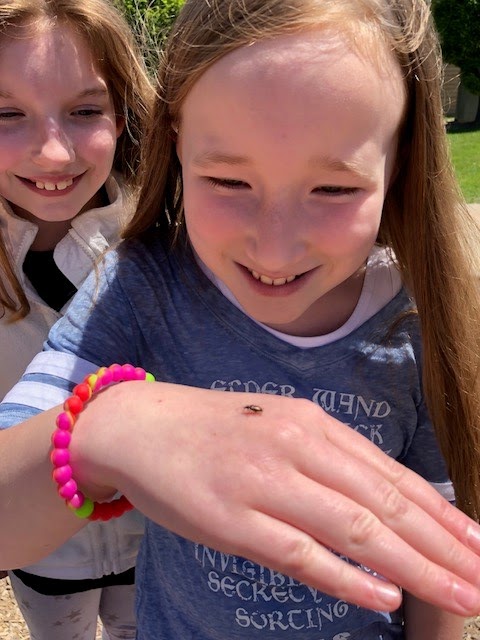
Student with unidentified insect
The 2018-2019 school year begins soon!  Every August I look forward to meeting my new group of students.  It is always exciting and a bit intimidating.  Although I've been teaching for over twenty years, each class holds the promise of new adventures and new struggles.  Each year I meet a new group of students with their own unique hopes and dreams for fourth grade.  I hope I don't let them down and that I can help them along their educational path.  Each year we have new curriculum and new learning targets.  All of these unknowns leave me a bit anxious during my last days of summer break.  That being said, there are also some deep truths about teaching and learning that don't change much over time.  Great thinkers have been sharing their knowledge about learning throughout the ages and they continue to inspire us with their truths.  Here are a few that come to mind. . .
"Tell me I forget, teach me I remember, involve me and I learn."  --Benjamin Franklin

"Imagination is more important than knowledge."  --Albert Einstein 

"Each life is made up of mistakes and learning, waiting and growing, practicing patience and being persistent."  --Billy Graham

"Some things are true in spite of statistics and philosophy and tabulations.  Some things we know because we know them."  --Liberty Hyde Bailey, Universal Service, 1918


"There is no way to help a learner to be disciplined, active, and thoroughly engaged unless he perceives a problem to be a problem or whatever is to-be-learned as worth learning, and unless he plays an active role in determining the process of solution.  That is the plain, unvarnished truth, and if it sounds like warmed-over "progressive education," it is not any less true for it."   --Neil Postman & Charles Weingartner, Teaching as a Subversive Activity, 1969


"Education is the lighting of a fire, not the filling of a pail." --WB Yeats 
   
There are many more quotes like these and they all point to truths about teaching.  None of them talk about curriculum, content or delivery.  They all point to something bigger and more universal.  Teaching is more than what we learned in graduate school or a trick or a performance or a chromebook.  It is more than the latest formulated curriculum or set of goals and objectives.  Teaching is an art.  And like art, it is always unique and takes many forms and shapes based on the students and the teacher and even the moment.  Sometimes I fail miserably.  Sometimes I'm amazed by what students are able to learn and discover.  But always it is a new adventure.

In these last days of August, there are many small projects that occupy me. . . setting up my classroom, gathering supplies, reacquainting myself with curriculum and planning the first few weeks of school.  The outdoor learning center needs attention.  There are weeds to pull and beds to mulch.  In addition, I'm raising about twenty monarchs (I will bring to school) that all need fresh milkweed on a daily basis.  And Harold, our class pet, needs to readjust and return to the classroom.  There are lots of things on my mind.  But mostly, I realize that in a few weeks my new students and I will embark on a new adventure.  Hopefully, it will be a year full of discovery, inspiration and joy.

To everyone returning to school, I hope that your next year is a great adventure!

Peace and Love

Tuesday, June 5, 2018

Birding, Planting and Enjoying the Last Days of School

Russ helping us identify a bird in the yard
Planting Milkweed in our Butterfly Garden


Planting milkweed (Asclepias tuberosa)


Today we had the wonderful pleasure of going on another birding expedition with Russ Schipper in our backyard!  What fun!  We saw lots and lots of birds and heard even more!  It's amazing how many birds inhabit our forests, wetlands and grasslands at North Shore!  In addition, Russ brought with him a flat of Asclepias tuberosa (a form of milkweed) from his lovely wife, Ilse.  My students and I planted it around the edges of our new Butterfly Garden.  With a bit of rain, sunshine and good luck we will have even more great looking milkweed growing this summer!  Earlier this fall we planted lots of native plants thanks to a grant from The Wild Ones.  The monarchs will have great nectar sources, along with a variety of milkweed options to lay their eggs.  Two of our raised beds now have hearty stands of Asclepias syriaca (common milkweed).  Hopefully, we are developing a grand smososbord for butterflies and other nectar feeders.   Thank you Russ, Ilse and everyone who has been helping us with our new garden!

Writing on the trial

Journaling
Recess with friends!

Saturday, April 28, 2018

Spring Education

Study in our bulb garden


"Science but increases the mystery of the unknown and enlarges the boundaries of the spiritual vision.  To feel that one is a useful and co-operating part in nature is to give one kinship, and to open the mind to the great resources and the high enthusiasms.  Here arise the fundamental common relations.  Here arise also the great emotions and conceptions of sublimity and grandeur, of majesty and awe, the uplift of vast desires,--when one contemplates the earth and the universe and desires to take them into the soul and to express oneself in their terms; and here also the responsible practices of life take root."  

--Liberty Hyde Bailey, The Holy Earth


Running on the trail

Writing in Writer's Notebook


It's spring and we are back to running every morning on the trail!  Our bulb garden is up!  The spring peepers and the red-winged blackbirds are singing!  The bird feeders are emptying at an incredible pace.  There are signs of life everywhere!  My class and I are turning our minds toward the season of spring and looking toward that amazing summer break that promises barefeet in the warm sand and lazy bike rides down the Kal-Haven trail.  It makes it a bit hard to stay inside.  

This past week, we celebrated Earth Day.  We picked up garbage on our campus and wandered over to the middle school to clean up their campus as well.  We learned how to make recycled paper (paper we will use for a special writing project in May).  We picked daffodils in the "hidden garden" (a huge patch in the woods) and we studied our own bulb garden.  I shared some of my favorite Earth inspired books (Dear Children of the Earth, The Other Way to Listen, Just a Dream, and Whisper from the Woods).  
Mother to Mother image found in Dear Children of the Earth
Written and Illustrated by Schim Schimmel
The above picture is from one of my favorite pages in Dear Children of the Earth.  The book is written as a letter from Mother Earth to us.  On this page, Mother Earth says,
 " . . . I need your help.  And the animals need your help, too.  "But Mother Earth," you ask, "how can I help you and all my sister and brother animals when you are so big, and I am so small?"  Well, my children, let me tell you something, I am not so big.  As a matter of fact, I am quite small.  When you go outside at night and look up at all the millions and millions of stars, you will see how small I really am.  Compared to the night sky, I am no bigger than you!"
What a powerful image.  The story continues by asking the children what they think is the most important thing they can do to help her (at this point students have all kinds of ideas).  The response is simple . . .
"I need you to love me.  That's all.  Just love me as much as I love you.  Because when you love me, you will care for me.  And when you care for me, you will protect me.  And when you care for me and protect me, you will save your Home, and the homes of your sister and brother animals."
 My students wrote letters back to Mother Earth after this inspiring and beautiful book.   They did a wonderful job and the letters were filled with love.  I was so pleased.

Cover and letter written to Mother Earth

"...when one contemplates the earth and the universe and desires to take them into the soul and to express oneself in their terms . . . the responsible practices of life take root."
I am reminded that education is more than facts, it's an emotional relationship.  Happy spring everyone!
  

Friday, March 30, 2018

Spring and the Irony of Education

Spring
By Mary Oliver
Somewhere
     a black bear 
          has just risen from sleep
               and is staring

down the mountain.
    All night
          in the brisk and shallow restlessness
               of early spring

I think of her,
     her four black fists
          ficking the gravel,
               her tongue

like a red fire
     touching the grass,
          the cold water.
               There is only one question:

how to love this world.
     I think of her
          rising
              like a black and leafy ledge

to sharpen her claws against
     the silence
          of the trees.
               Whatever else

my life is
    with its poems
          and its music
              and its glass cities,

it is also this dazzling darkness
     coming
          down the mountain,
                breathing and tasting;

all day I think of her---
     her white teeth, 
          her wordlessness,
               her perfect love. 


There is a great irony in education these days . . . maybe its always been this way and I've just started noticing it more . . . . maybe it's my years of listening to children or my own personal love of learning. I'm finding that the process of  learning is less and less respected and harder and harder to come by lately as we focus more and more on the product . . . I don't know. . . my imagination is falling short in the face of this national educational crisis.  We are not getting smarter and there is something we are losing . . . 

It has become really easy and slick to test students on details and facts.  We can give an online test and have it scored in minutes and know the percentage of students who missed question number 8 and discuss why they missed it and how we can better teach that answer next year . . . but we often don't bother to question the question or what we are actually testing.  It is a genuinely a good question?  And don't we realize that every computer generated question, has a computer generated answer and that those questions and answers can be done by computers?  What's the point?   Isn't it all obsolete with A.I. (Artificial  Intelligence)?  Why does anyone in this day and age think facts are more important than thinking?

Where is the poetry?  Where is the music?  Why aren't we learning to love the quest for knowledge over facts?  When will we embrace the wisdom of Albert Einstein, when he said, Imagination is more important than knowledge?  Doesn't he know something about learning?  When will professionals, that step everyday into a classroom, get heard when we say, enough is enough with all these tests?!  

There is only one question:
    How to love this world.

I often turn to Mary Oliver for wisdom.  It's not the kind that is generated by Siri or some other AI (I use AI to figure out how to make my way to some destination or to give me some random fact).  AI is very handy, but Mary Oliver reminds us that spring is here and there are bears that wake up and remind us who they are . . .

. . . this dazzling darkness 
coming 
down the mountain, 
breathing and tasting;  

all day I think of her--
her white teeth, 
her wordlessness, 
her perfect love. 

I don't know how to express how much we need to listen to the poets and artists of our time.  I don't know how to express that we need to encourage imagination in our students in a world that seems so lacking in vision.  And maybe even more, we need to listen to the bear that wakes in spring and the birds that build their nests and the snails and the plants and the songs that persist in our hearts.  There is only one question:  How to love this world.  This is where learning and exploring begins and ends. . . all the rest is just. . .all the rest.   


Saturday, February 24, 2018

The Great Backyard Bird Count With Russ Schipper!

Pointing out the Rock Pigeon on the roof
Russ answering questions in the field


On Monday, February 19th, my class had the good fortune of having Russ Schipper take us birding for the Great Backyard Bird Count, through Cornell University.  We walked, looked and listened on the school grounds for signs of birds.  It's pretty amazing the number of birds you can hear when you are quiet and listening for them!  Russ is an avid birder and educator of all things bird related.  He is a leader in the Kalamazoo Audubon Society, no doubt sharing his knowledge and love of birds with its members as well as the young students he teaches.  This has become an annual tradition with Russ and I (every year for the past 6 years) and it is an honor be a part of it.  Each year, it is a new adventure.  This year was very wet (we had just had a huge snow melt) and so we kept to paved surfaces.  The forecast called for rain but thankfully the rain held off.  We spotted and recorded lots of birds in our fifty minutes outside.  We sent our results into the Cornell site after we reviewed our findings in the classroom.  (If you go to: http://gbbc.birdcount.org/  you can see our findings along with millions of others.)


Russ comes to North Shore Elementary every fall and gives a presentation to each classroom on birds (4th graders) and owls (5th graders).  He is a gift to our school and to the many other schools that he visits.  He has actually visited hundreds of classrooms and never tires of a student or a question.  Russ has spread this love of birds to thousands of people both young and old.

All of Russ' work educating us on birds is really rather incredible, but he shares more than his bird knowledge with us-- he shares a model of good living.  We have a lot of programs trying to tell students how live . . . how to be kind or how to do the right thing or how to treat people right. . . Here's what I think. . . It's people like Russ that show us how to live.  And it is people like Russ that change the world for the better. . . one child, one bird, one teacher at a time.   Russ exemplifies  the notion that no question is too small, no child is unimportant and that everyone has a place and can learn.  And he exemplifies the art of generosity, both with time and birdseed (I have a huge stash of sunflower seeds from him for our schoolyard birdfeeders).   Many years ago a wonderful mentor of mine (Marianne Hueston) told me, "You teach who you are."  As a seasoned (some might even say old) teacher, I have learned over and over again that this is true and very wise.  If we genuinely want to teach children curiosity, kindness and generosity we need to model those traits.  Teaching doesn't happen from talking (or testing) it happens from being.  A huge thank you to Russ for his many teaching gifts!  I'm looking forward to next year!

Tuesday, November 28, 2017

Wisdom

My Parents with Lena
"There are many great deeds done in the small struggles of life."  --Victor Hugo

The above photo is of my parents; a couple of heros of mine.  They have both spent their lives in service to others and they continue to model that lifestyle.  My parents continue to teach who they are by their actions and the way they live every day of their lives.  I will share just one story that captures a bit of who my mom is. . . My mom lives with Parkinson's disease.  It has made it hard to communicate and perform some of the basic tasks in daily living.  My dad is her constant companion, helper and caregiver.  He is pretty amazing and I could write a great deal on his accomplishments, but that is not the story for today. . . My story for today is about a recent hospital visit I took to see my mom and a bit about her story.  My mom was in the hospital suffering from pneumonia.  She has weak lungs and the Parkinson's disease makes this complicated and dangerous.   At any rate, my mom was in the hospital and very frail.  The nurse was trying to bring her into conversation.  My brother and I started telling stories about her years as a junior high school home economics teacher.  She taught in an inner-city school in an American Indian community on the southside of Minneapolis.  There was a great deal of poverty, alcohol abuse and broken families in that community. . . issues often associated with a culture that has been displaced and so often disrespected in our wider society.  On that day in her hospital room, we recounted a story about one of her students that spent most of the afternoon in her classroom.  He was technically not assigned to all her afternoon classes but he was such a distraction and discipline issue, spending the afternoon in home economics seemed the least harmful.  He was a handful.  One day my mom was out sick and a substitute teacher was in her room.  The notes very specifically said that this student was not allowed in the hallways without supervision.  The substitute however, allowed him a bathroom break thinking no great harm could possibly happen.  Within a few minutes, he had started a fire in the bathroom and there was smoke everywhere.  The entire school had to be evacuated.  The principal later told my mom to give him a heads-up next time she would be gone, so that he could made sure that student also took the day off.  The nurse in the room said, "Boy, I bet you were glad to retire!"  My mom, who struggled to get out every word, said, "I felt privileged to be a part of his life."  And then she said, "I was talking to a student once and he said (with junior high angst) "Why should I listen to you?!""  My mom responded, "Because I care about you."  The student looked at her and said, "No one has ever said that to me before."  My mom's class became a refuge for those who needed a safe place and genuinely needed someone who cared about them.  They were lucky to have her as a teacher and no doubt they were better people because of her.  And my mom really was privileged to be a part of their lives.

Today, my mom struggles with many of the things most of us take for granted.  She has a hard time telling her elbow to bend so that she can bring the spoon to her mouth to eat.  She has a hard time putting thoughts into words and speaking what is on her mind.  She struggles with balance and all sorts of daily activities we take for granted.  But here is what I notice now more than ever . . . she is strong.  She struggles through each day and still smiles when she sees someone she knows.  She continues to care about other people, when it may seem that her own struggle is more than enough to care about.  She continues to teach us how to live and she continues to be a hero to those of us who know her.  I know that I speak for my whole family when I say, we are lucky to have her in our lives.  She and my dad have taught us over and over again that caring for others is a way of life and a privilege.  This is an amazing gift and lesson that my brothers and I were fortunate enough to receive.  Teaching is so much more than what we say.  Teaching is about how we live our lives.  Thanks Mom and Dad!    

Friday, October 6, 2017

Outdoor Learning and Common Core Curriculum


A child's world is fresh and new and beautiful, full of wonder and excitement.  It is our misfortune that for most of us that clear-eyed vision, that true instinct for what is beautiful and awe-inspiring, is dimmed and even lost before we reach adulthood.  If I had influence with the good fairy who is supposed to preside over the christening of all children I should ask that her gift to each child in the world be a sense of wonder so indestructible that it would last throughout life, as an unfailing antidote against the boredom and disenchantments of later years, the sterile preoccupation with things that are artificial, the alienation from the sources of strength. 
--Rachel Carlson, The Sense of Wonder


Every morning (weather permitting) I take my students on a short run around the lower loop trail.  We are outside for maybe five minutes. . . just enough time to get our blood flowing and prepare for the day.  It's also just enough time for students to catch up with each other and with me.  I hear about their latest soccer games, a favorite book or the reason homework isn't quite done.  Sometimes we are graced by a large flock of geese that like to graze on the soccer fields nearby and then take flight over our heads.  Sometimes the moon is an amazing crescent and we watch it wax or wane over the next few days.  Sometimes we find strange fungus growing out of the ground after a rain that seems to have appeared overnight out of nowhere.  Sometimes we see a monarch and wonder if it was one we released a few days earlier.  Those moments outside in the morning often offer something to amaze us and our days are brighter for it.


Earlier this year, my students helped plant our butterfly garden.  They learned about parts of the plant and what plants need to survive.  They learned a bit about producers and their place in ecosystems.  We have had hot and dry weather since our plantings so during recess, volunteers have been helping me care for the plants.  We carry gallon jugs of water out to them and check on their progress.  As we walk, again, we have time to talk and catch up on what is going on in their lives.  When we get to the garden, they examine the plants that they planted and others that they did not plant.  I hear them call to each other, "Make sure we get them all, don't leave anyone out!"  We empty our jugs and students run to catch the last few minutes of recess.  Maybe the words, "don't leave anyone out" are still ringing in their ears (I hope so).


In past posts, I have examined a variety of ways to teach in our outdoor learning center.  The most obvious connections are in math and science, but we also go outside to inspire our poetry writing.  These lessons connect with our Common Core Curriculum.  If I am teaching perimeter and area, we will go out and measure our raised beds.  The bonus is, we will also measure the height of the plants and estimate the total number of plants in the garden.  Maybe students will even learn the name of a plant or two.  These are extra teaching points that I can slide in (also most likely in the Common Core Standards).  It's not hard to connect our curriculum to the outdoors.

There is a lot of debate over Common Core Curriculum.  For those of you who are not in education, Common Core Curriculum has the goal of making educational standards that are nationwide.  They are the lists of things that we should be teaching at each grade level.  The concept is that students are roughly getting the same knowledge or information at each level no matter where they live in the country.  That's not a bad concept.  In our culture, families are pretty mobile and it would be great to know that you could move anywhere in the United States and the educational expectations are about the same.  I don't have a problem with this concept and the ongoing development of a Common Core Curriculum.  It isn't the evil (in my mind) some make it out to be in our new centralized and politicized educational system.  We have always had standards and benchmarks, now they are a bit more specific and we are encouraged to make note of them in our lesson plans (something tedious but not too hard with computerized lesson plans).  It's not the Common Core Standards that weigh us down. . . it's how we have decided we use them that have made them a burden.  The standards are a tool and a guide; they are not how we teach and they aren't even what we teach.  We teach children.  We teach children.  I say this twice because it bears repeating.  The Common Core is a framework for professional teachers to use as a guide in their classroom.  It's nothing more than that.

It is when we use standardized tests to measure achievements of the Common Core Curriculum and then we set point goals for students that we have taken a step down a rabbit hole that leads us off course.  And that is when the tools of Common Core become a burden that seems to take over our classrooms and our lives.  We now require our students to take online, high stakes tests throughout the year.  In the fall, the tests (in math and reading) determine where a student is academically and an algorithm will project where that student should be by the end of the year.  Unfortunately, measuring and projecting growth for children is a bit difficult and the algorithms are flawed.  I have lots of examples of this, but I will share just one.  A couple of years ago, I had a really good math student.  His fall scores were high and his expectations (via the computerized algorithm) were high.  At the end of the school year, this student scored in the 99th percentile in math (in the country)!  Amazing.  You can't score higher than 99 percent, however, he was somehow one point away from his goal.  I received an email from his mom later that night.  She said that he had cried himself to sleep because he hadn't made his math goal.  I called her and reassured her that her son was amazing and could not have scored better.  When the student came to class the next day, I explained to him that he was well within the margin of error (something that isn't taken into consideration by our administration, although is proper statistical analysis) and he could not have done better.  His score caused unnecessary grief and his score was actually amazingly good.  There are similar issues with students who have low test scores, as their projected growth requires more than the average point gain.  This is because the algorithm expects teachers to "close the gap" with our low students.  Students who may have taken five years to make perhaps three years growth are expected to make more than a year's growth to help "close the gap" (this projection is often naive and without logical basis).  In addition to unrealistic goals, there are emotional issues, test taking fears, and wasted educational time (we spend hours and hours every year testing).  However, when we see the bar graphs as full-color, glossy, and well formatted printouts, they look so good that we are often lulled into thinking they must be right.  They are all wrong.    To return to Carson again, they are "the sterile preoccupation with things that are artificial, the alienation from the sources of strength."       


The other morning when we were out on our daily run, we noticed a loud flock of geese in the yard.  They were landing in groups of six and eight and they were squawking and carrying on as if there was some sort of family disagreement going on.  Later that morning, while I was in the midst of teaching reading (I can't recall the lesson) that flock of geese starting walking toward our classroom windows.  We stopped and watched. . . "What are they eating? . . . How can you tell the females from the males?"  We watched carefully (my lesson not nearly exciting enough to compete) and we decided they were eating the grass, not really digging up insects.  I got on my phone and asked Siri how to tell the difference between male and female Canada geese.  Apparently, the males are slightly larger but the color patterns are the same.  Moments later, the flock took flight and we resumed our lessons.  I don't remember the language arts lesson, but I remember what I learned about geese.  I'm guessing it was about the same for my students.  Moments like that are joyful and full of wonder and excitement.  That is what I want to encourage and that is what I needed to teach in those few moments.  Isn't that what we want for our children. . .?

If I had influence with the good fairy who is supposed to preside over the christening of all children I should ask that her gift to each child in the world be a sense of wonder so indestructible that it would last throughout life. . .

My hope for the future of education, is that we turn away from high stakes testing so we can fully focus on the amazing children that enter our classroom.  Let's remember that curriculum is just a list of things to teach and that we are here to inspire our students and help them to hold onto the wonder that is childhood.  And perhaps it's the little moments that make the day joyful . . a flock of geese, a walk to the garden or a view of the moon and those little moments are what can inspire us to learn and grow.  Happy teaching and learning!